
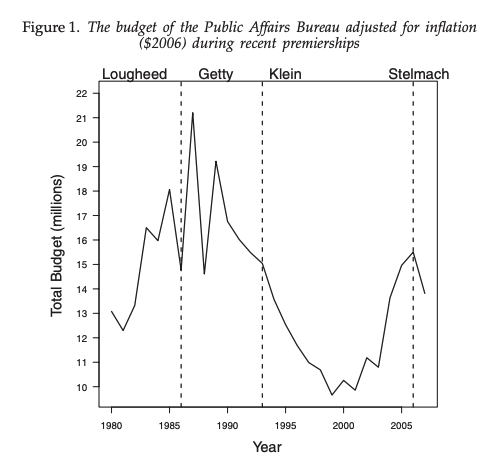
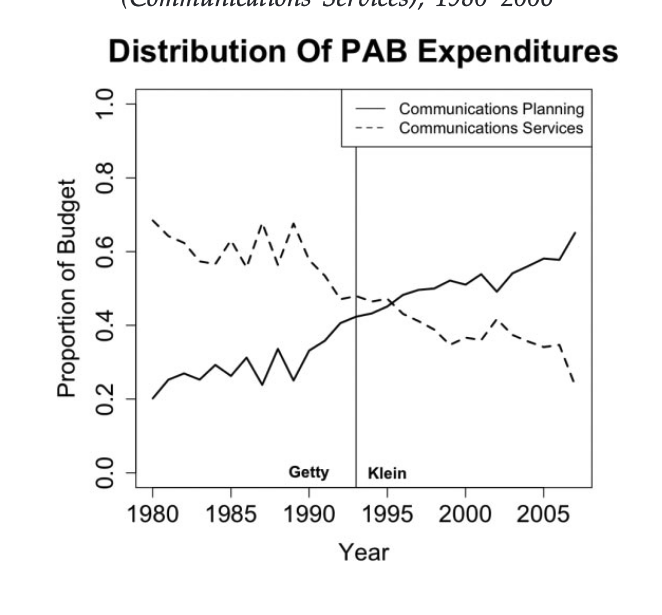
 support for communications activities. However, it changed the focus of the government’s PR unit to be much more politically sensitive and playing a role shuttling between the political leadership and public opinion (see below).
  .
. .
.Publications
George W. Wootten & Simon J. Kiss
Canadian Journal of Political Science
Canadian Journal of Political Science
Political Communication
Copied!
—
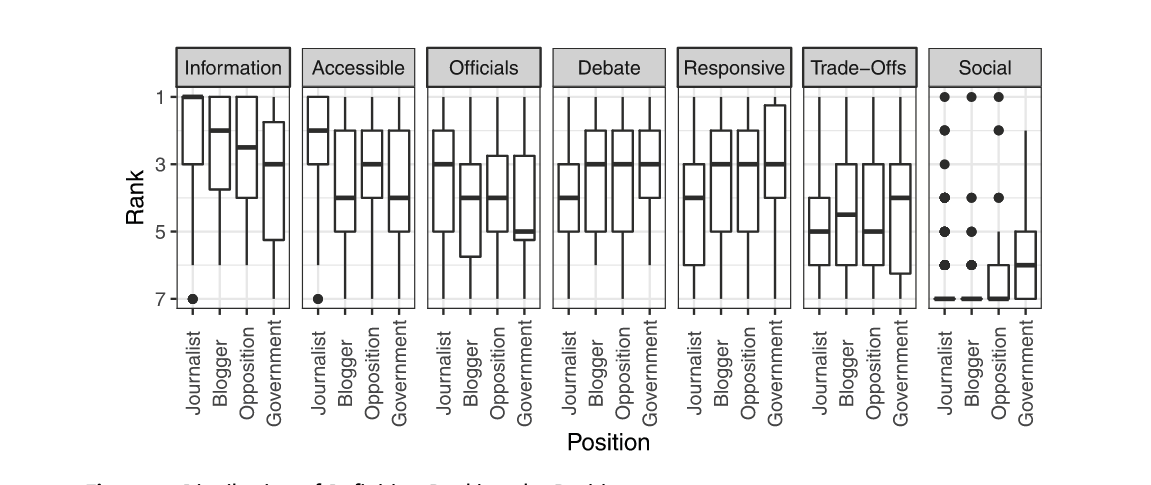
We present the results of a 2014 survey of Canadian parliamentarians, journalists and bloggers in which respondents were asked to rank competing definitions of open government. Overall, respondents preferred to define open government in terms of access to information and sources. However, controlling for age, ideology and language, we also found that respondents in the different positions ranked definitions of open government differently. Journalists are more likely than any other group to define open government in terms of access to information and sources. In contrast, parliamentarians who were members of a governing party were as likely to choose definitions of open government that emphasized public participation as they were to choose definitions that emphasized access to information. Opposition parliamentarians share more similarities with government parliamentarians than with journalists. These results suggest that key actors in the Canadian policy landscape define open government in ways that are consistent with their institutional interests. We suggest that these results reflect ways in which open government operates more like a buzzword, which helps explain the common pattern whereby opposition parties make promises to be more open and, after taking power, operate in less open ways. Moreover, these results raise questions about the extent to which open government can actually operate as an organizing principle.
@article{woottenAmbiguousDefinitionOpen2019,
title = {The {{Ambiguous Definition}} of {{Open Government}}: {{Parliamentarians}}, {{Journalists}} and {{Bloggers Define Open Government In Accordance With Their Interests}}},
author = {George W. Wootten and Simon J. Kiss},
volume = {52},
number = {3},
pages = {479--499},
doi = {10.1017/S0008423918000446},
url = {https://www.cambridge.org/core/product/identifier/S0008423918000446/type/journal_article},
year = {2019},
month = {sep},
note = {Last visited on 02/06/2025}
}
Simon Kiss, Karly Rath & Andrea Perrella
Canadian Journal of Communication
Canadian Journal of Communication
Political Communication
Copied!
—
Background Public opinion surveys usually report majority support for fluoridation in North America. Yet many local plebiscites produce opposite results. One possible reason is the nature of local media coverage. Analysis This article reports on a content analysis of news coverage and letters to the editor about a fluoridation plebiscite in Waterloo, Ontario. Qualitative research suggested that the groups opposed to fluoridation were more motivated and better organized than those in support. The net effect was news coverage more neutral toward fluoridation than supportive or critical, predominantly framed in terms of risks rather than benefits. Conclusion and implications The findings here emphasize the reactive nature of contemporary journalism. In local fluoridation plebiscites, champions are required to produce news coverage that better conveys the benefits to the public.
@article{kissBalancedJournalismAmplifies2018,
title = {Balanced {{Journalism Amplifies Minority Voices}}: {{A Case Study}} of a {{Fluoridation Plebiscite}}},
author = {Simon Kiss and Karly Rath and Andrea Perrella},
volume = {43},
number = {4},
doi = {10.22230/cjc.2018v43n4a3355},
year = {2018},
month = {nov}
}
Simon Kiss
Canadian Public Administration
Canadian Public Administration
Political Communication
Copied!
—
This article examines the rise of more strategic, professional and politically sensitive communications in the Government of Alberta and argues that citizen demands for transparency and participation are also reasons for the increased importance of strategic government communications. Accommodating these demands in the context of traditional representative democracy requires politically sensitive staff who can manage processes without jeopardizing the government's re‚Äêelection or policy agenda. This article draws on analyses of government documents, interviews and the archives of premiers Getty and Klein.
@article{kissRespondingNewPublic2014,
title = {Responding to the '{{New Public}}': {{The Arrival}} of {{Strategic Communications}} and {{Managed Participation}} in {{Alberta}}},
author = {Simon Kiss},
volume = {57},
number = {1},
pages = {26--48},
doi = {10.1111/capa.12053},
year = {2014},
month = {mar}
}